Indiana Jones and the Kingdom of the Crystal Skull (2008)
DIRECTOR: Steven Spielberg
CAST:
Harrison Ford, Shia LaBeouf, Cate Blanchett, Karen Allen, Ray Winstone, John Hurt, Jim Broadbent
REVIEW:
Indiana Jones and the Kingdom of the Crystal Skull, coming nineteen years after the so-called Last Crusade; nineteen years for fan expectations to climb to levels no film can satisfy. Series writer George Lucas has previously felt the wrath of disappointed fans with his Star Wars prequels sparking (over-the-top) accusations of ruined childhoods, and now he gets to experience it again. Part of it is surely that it’s simply been a very long time since Indiana Jones rode into action, and it is perhaps unfair to expect the new installment to recapture the old magic where it left off. But it’s hard to give Lucas and director Steven Spielberg too much slack, because even all things considered, Indiana Jones and the Kingdom of the Crystal Skull is as unwieldly as its overlong name, the most lifeless entry in the series, overplotted, unevenly paced, and meandering, and feels like a superfluous entry in a series that’s past its prime.
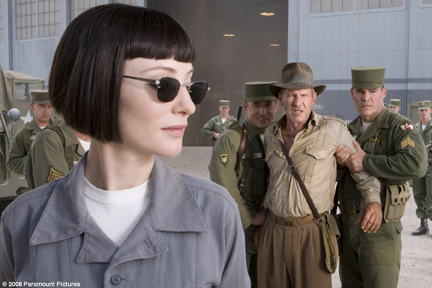
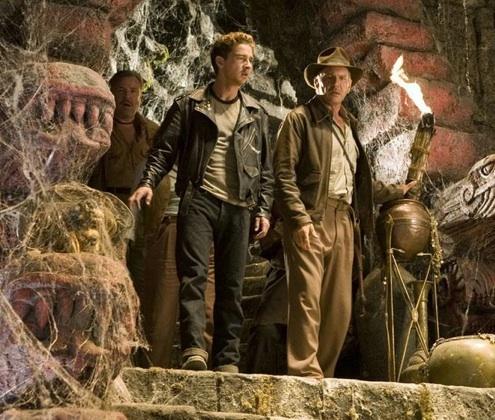 We start with the requisite Indy prologue in 1957 Nevada, where Soviet KGB agents led by Irina Spalko (Cate Blanchett, sporting a tight Soviet uniform, her hair in a black bob cut, an icy expression, and a Russian accent; she never tells Indy ‘ve have vays to make you talk’, but she always seems like she’s about to) have dragged a kidnapped Dr. Jones (Harrison Ford) and his latest sidekick, the unreliable Mac (Ray Winstone), to a secret US army warehouse (the same warehouse where the Ark of the Covenant was stashed away at the end of Raiders). There is something there Spalko wants, and she intends on forcing Indy to find it for her. The item in question turns out to be the legendary Crystal Skull, which she believes has paranormal powers. Apparently Spalko was Stalin’s foremost expert on paranormal studies and believes the skull can be a weapon to tip the scales of the Cold War in the Soviet Union’s favor. Of course this scene ends with a daring Indy escape, and one of the movie’s most clever bits. Indy, on the run from the pursuing Russians, blunders into a town in the middle of the desert, only to find that it’s eerily populated entirely by mannequins, and as the siren begins to wail, realizes to his horror that it is an artificial town built to study the effects of an atomic bomb blast. Making an unlikely but creative escape from seemingly certain doom with the help of what has to be the sturdiest refrigerator on the face of the Earth, Indy eventually manages to make it back to his teaching duties at Marshall College (the first shot of Indy’s university, which looks exactly the same, brings back nostalgic memories). But his troubles are a long way from over. In the climate of 1950s anti-Communist paranoia, Indy’s ‘collaboration’, however unwilling, with Soviet spies, has the FBI taking ‘great interest’ in him, and the sympathetic dean (Jim Broadbent, basically filling in a couple scenes that in the 1980s would have been played by the late Denholm Elliott) has been pressured to show him the door. Indy packs his bags, but no sooner has he boarded the train than he’s approached by a motorcycle-riding young punk called Mutt Williams (Shia LaBeouf), who looks and acts like a Marlon Brando/James Dean wannabe and has come for Indy’s help in finding his mother, who went missing in Peru while herself searching for Professor Oxley (John Hurt), an old colleague of Indy’s, who went mad while obsessively seeking the Crystal Skull. Indy isn’t sure exactly what any of this has to do with him, until he finds out the boy’s missing mother is none other than his old flame Marion Ravenwood (Karen Allen). With Mutt as his self-appointed latest sidekick, Indy sets off on a new adventure that will take him to the depths of the Peruvian jungle, and finds himself in a race against the Soviets led by Spalko to find the legendary Kingdom of the Crystal Skull.
 If the above sounds unnecessarily convoluted, that fits the tone of the movie, which has a tendency to get long-winded about things the others wisely kept simple. The Crystal Skull (or skulls, as it turns out) is given the most laborious backstory of any of the series’ MacGuffins, with both Indy and Spalko delivering swaths of exposition about it. The old movies had the right idea; a quick summary and move on. After all, the joy of any Indiana Jones film is not the destination, it’s the journey. The Crystal Skull, like the Ark of the Covenant, the Sankara stones, and the Holy Grail, is a plot device to move us from point A to point B and string the action sequences together. Also, while they’re an obvious choice for the bad guys given the Cold War 1950s setting, the Soviets are somewhat weaker villains than the Nazis. Even Steven Spielberg himself noted once that Nazis are so easy to use as villains because they are a virtually universal symbol of evil; the Soviets just don’t generate the same boo hiss effect. Spalko’s motives are a little murky; a bunch of vague rambling about psychic warfare, using the supposed vast combined mind-controlling power of the reunited skulls to take over the US without firing a shot (‘we will change you”, she says, “and the best part is, you won’t even know it’s happening’). The old movies kept the bad guys’ motives simple: power, world domination, eternal life. Spalko’s seem both underdeveloped and over explained.
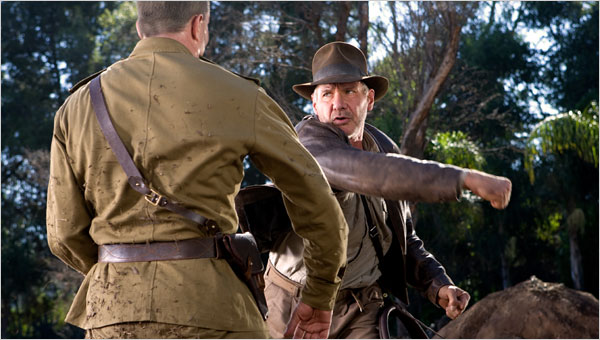 The problem isn’t the cast. Despite the nineteen years that have passed since he last donned the fedora, Harrison Ford slips back into Indiana Jones’ outfit and persona like an old, well-worn, comfortable shoe. Indiana Jones has always been the role Ford seems the most perfectly at home in, and he does an admirable job of slipping back into a character he last played in 1989. It’s telling of Ford’s enjoyment of the role that after a string of bored, autopilot performances in recent roles, he seems easily the most invigorated and enthusiastic here that he’s been at least since 1997’s Air Force One. Of course Ford is much older than in The Last Crusade, and the filmmakers don’t ignore the obvious fact that he is no longer a young man.He’s helped by a screenplay that acknowledges the gap of time and the actor/character’s age. Indy is still in the thick of the action, but the number of extreme stunts (at least those performed by Ford) has been scaled back a few notches, and he’s backed up by the largest group of sidekicks he’s ever had. This time the filmmakers allow Indy to acknowledge that he’s not a young man, and to be a little more of a team player.
 Shia LaBeouf is effective sidekick material. For the very busy young actor, this isn’t the kind of role that’s going to win him acting accolades, but like last year’s Transformers, it’s a further stepping stone toward stardom, and if nothing else LaBeouf, known so far as geeky boy-next-door types, shows that he can venture more into action hero territory without seeming ridiculous. Mutt compliments Indy well, mainly because he’s almost certainly the closest any sidekick has come to being an equal. He’s certainly a lot more appealing and a lot less irritating than Willie Scott or Short Round, and he can take care of himself in a scrape. It’s nice to see a familiar face other than Ford in the form of Karen Allen’s Marion (generally considered his worthiest love interest), but while Allen is throughout the second half of the film, and seems to be having fun returning to the series, she isn’t given much to do besides take the wheel during the lengthiest car chase, and resume her bickering with Indy for a short time before they get mushy like long-lost loves. It’s a bit disappointing that we don’t get any kind of smackdown between Marion and Spalko; in fact, the two women in the cast interact only fleetingly, and Marion doesn’t get to throw a punch. The supporting cast is talent-heavy with highly-regarded character actors- Cate Blanchett, Ray Winstone, John Hurt, Jim Broadbent- none of whom are given anything challenging. Cate Blanchett is underused, not given much to do besides stalking around looking stern, providing exposition about the Crystal Skull, threatening various characters with her rapier, and chasing Indy and company around the jungle, and is nowhere near Ronald Lacey’s Toht’s or Amrish Puri’s Mola Ram’s levels of nastiness. In fact, she’s disappointingly bland. Ray Winstone’s Mac is a plot device who switches allegiances whenever the script needs another twist. John Hurt is even more wasted, given nothing to do but wander around looking vacant and muttering unintelligibly. Even when he finally becomes lucid again, it’s too late for him to make an impression, and even then his utterances are less than profound; when Indy asks if the skulls’ owners have returned to outer space, Oxley replies ‘not space, but the space between spaces’. Huh? Part of what sometimes drags Crystal Skull down is the excess of supporting characters; what makes it worse is that they’re as flat as the pages they’re written on. Granted, we don’t come to Indiana Jones movies for deep character development, but previous supporting players, like Karen Allen’s Marion, Paul Freeman’s Belloq, Ronald Lacey’s Toht, and John Rhys-Davies’ Sallah all had a spark of something distinct about them that Spalko, Mac, and Oxley are missing.
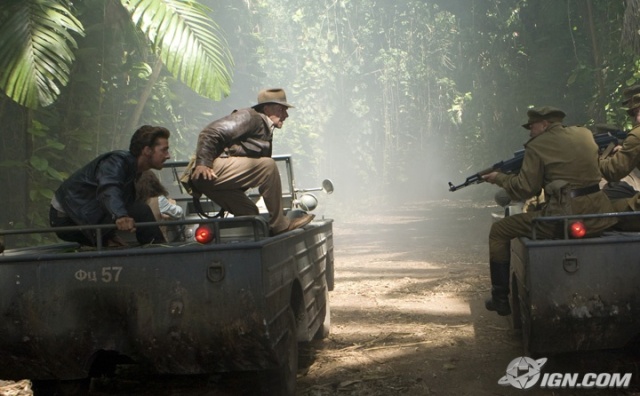
The only thing belying that Ford’s not as light on his feet as he used to be is the noticeably reduced number of major stunts he performs. That’s not to say he doesn’t do any, they’re just not the steady series he performed in previous outings. Ford’s best stunt work (if it’s all actually Ford, and it appears to be), is in the first third, especially during his warehouse escape, where he whips guns out of the bad guys’ hands, scrambles around over mountains of crates, swings from the rafters onto moving cars, and basically establishes that Indy is still Indy. It’s good that he gets this showcase, because after that Indy spends most of his time on the ground. There’s two car chases, and a fistfight, but not much swinging around (at least not by Indy). The next big action scene is a chase with Indy and Mutt on Mutt’s motorcycle tearing around and through Marshall College with Russkies in hot pursuit that ends up in the library. Maybe the movie’s most memorable action bit comes during this sequence, in which Indy is pulled off Mutt’s motorcycle and into the Russians’ car, and manages to fight his way out the other window and back onto the motorcycle. It combines nifty stunt work and clever action-comedy in the best tradition of Indiana Jones. Unfortunately, the movie is low on action for a while after that, and we spend time on Indy and Mutt trekking around Peru and too much talking about the Crystal Skull. The movie’s key action setpiece, a lengthy and somewhat disorganized car chase through the jungle , is hampered by too much CGI and too much silliness, including Mutt swinging through the trees like Tarzan. The earlier motorcycle chase has a nicely old-fashioned, no frills feel, and would have fit perfectly at home in any of the previous films, but the jungle chase does not. Despite some nifty stuntwork with Mutt and Spalko fencing on the tops of racing cars, this sequence still feels a pale shadow of the truck chase in Raiders, the tunnel race in Temple, or the tank duel in Last Crusade, and is indicative of the way the overall energy level is lower here.
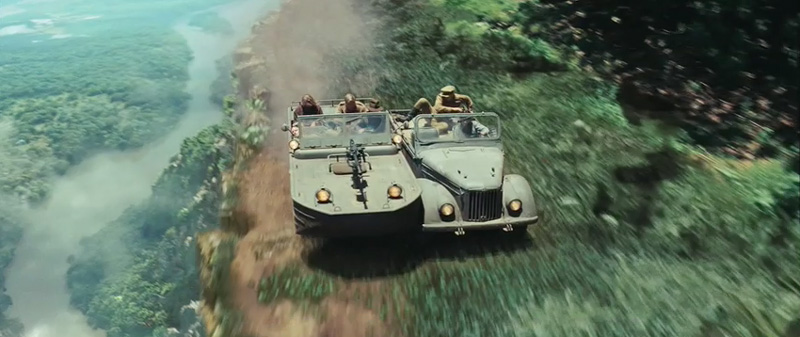 Spielberg and Lucas pull out all the stops to make this ‘feel’ like an Indiana Jones movie, relying in large part on the nostalgia many viewers will have for the original trilogy. There’s the old-fashioned Paramount mountain opening logo (one wonders if it’s a Lucas in-joke about lowering expectations when it turns into a prairie dog hill). We see pictures of Marcus Brody and Henry Jones Sr. Marshall College looks exactly the same. We revisit the same warehouse we saw at the end of Raiders, and the Ark of the Covenant makes a brief ‘cameo’. There’s the opening prologue action sequence featuring a tight spot and a daring Indy escape (although unlike the others, this one actually ties directly in with the main plot). There’s Indy’s fistfight with a hulking henchman, with Igor Jijikine filling in for the late Pat Roach. There’s also the obligatory creepy crawlies gross out moment, this time involving voracious red ants and borrowing a page from the man-eating beetles in The Mummy. The plot, while unnecessarily convoluted, very much follows the same blueprint as the others, particularly Raiders and Last Crusade: evil enemy military power seeks legendary object to tip scales in its favor, Indy and assorted sidekicks travel to remote regions racing against the baddies using clues in old legends and artifacts. There’s a ‘surprise revelation’ about a character that is unlikely to come as much of a shock for anyone who hasn’t been living under a rock for the past few months. The filmmakers also take advantage of the 1950s setting, starting right out with the opening, as Elvis Presley’s ‘You Ain’t Nothing But a Hound Dog’ blasts from radios, Howdy Doody is glimpsed on black-and-white television sets, Indy wanders onto atomic bomb test sites, his comeback when Spalko asks if he has any defiant last words is ‘I like Ike’ (this might go over some younger viewers’ heads, but some of the older audience members I attended with got a laugh out of it), and Mutt is introduced riding his Harley onto the screen dressed exactly like Marlon Brando in 1953’s The Wild One, down to the crooked cap. It has a lot of the familiar Indy ingredients, but there’s just not as much spark, and the energy and excitement level ebbs, with even the most exciting sequences not as exciting as what the series served up in the ’80s.
Another disappointing aspect is that the frantic second half never slows down enough for more than the most perfunctory ‘bonding’ between Indy and Mutt. There’s a missed opportunity to develop Indy and Mutt’s relationship into something like Indy’s relationship with his dad in The Last Crusade, another drawback of the excess of characters diluting the focus on the key relationship between Indy, Mutt, and Marion. Likewise, there’s still chemistry between Ford and Karen Allen, but their renewed relationship is given only the most perfunctory attention. One minute they’re bickering as though Raiders never ended, the next they’re getting mushy and giving each other adoring looks in between action sequences, which barely slow down long enough for them to catch a breath. This makes the epilogue in particular feel out of left field. It will undoubtedly provide satisfying closure for some Indy-Marion fans, but it doesn’t have enough leading up to it, and ends the movie on a somewhat ho-hum note. Spielberg and Lucas use CGI too liberally, throwing in some silly bits like reaction shots from animated prairie dogs (what, they couldn’t find any real prairie dogs?), and Mutt aping Tarzan (accompanied, as if the scene isn’t already goofy enough, by a small army of CGI monkies) at the lowest point of the jungle chase sequence. Indiana Jones movies have always been relatively tongue-in-cheek and not taken themselves terribly seriously, but these moments cross the line into too over-the-top attempts at comic relief.
Kingdom of the Crystal Skull isn’t unwatchable, but the freshness and energy of the original trilogy is sputtering at best. Harrison Ford still wears the fedora well, an underused Marion is better than no Marion, Shia LaBeouf is a welcome addition, and while the jungle chase gets a little carried away with CGI, . Nonetheless, the series is noticeably creaking with age here, and I think it’s time to Indy to hang up the whip.
**1/2
Elizabeth: The Golden Age (2007)
DIRECTOR: Shekhar Kapur
CAST: Cate Blanchett, Geoffrey Rush, Clive Owen, Abbie Cornish
REVIEW:
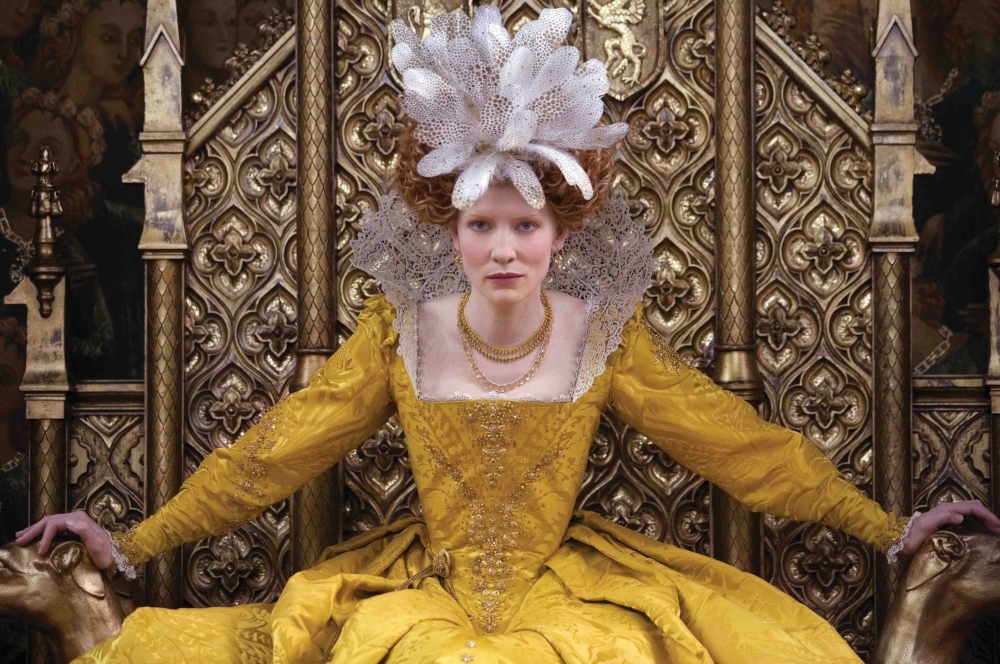
Shekhar Kapur’s sequel to his 1998 lavish historical costume drama Elizabeth, despite reuniting the director, screenwriter Michael Hirst, and stars Cate Blanchett and Geoffrey Rush, is an example of a sequel being, if not a precipitous drop, at least a downgrade from its predecessor. Elizabeth: The Golden Age, while including some rousing moments, too often feels more like a lavish costume soap opera than the intrigue potboiler of its predecessor.
Continue readingZodiac (2007)
 DIRECTOR: David Fincher
CAST: Jake Gyllenhaal, Mark Ruffalo, Robert Downey Jr., Anthony Edwards, Chloe Sevigny, Brian Cox, Elias Koteas, Dermot Mulroney, Philip Baker Hall, John Carroll Lynch
REVIEW:
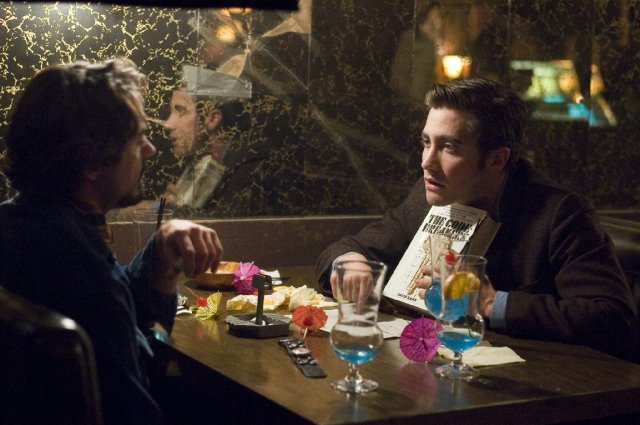
While it tells the true unsolved story of one of America’s most notorious serial killers–at least that which is publicly known–Zodiac is not a thriller, at least not in a conventional sense. Rather, it’s a police procedural and docudrama. Based on a true crime book by Robert Graysmith, it puts the focus not on Zodiac himself, who remains a shadowy, elusive, nameless and faceless figure (although the movie’s viewpoint, like Graysmith’s, is blatantly slanted toward one suspect), but on the men (including Graysmith himself) who were involved in the long-running, ultimately fruitless manhunt. To this end, Zodiac is a bit like a souped-up, two-and-a-half hour episode of Law & Order, and will appeal to some of the same audience fascinated by the details of police procedure and investigating. It depicts the above with slick polish and is often intriguing, but an uneven pace and the inevitable open ending will frustrate some viewers not strongly interested in the subject matter. Continue reading
The Good German (2006)
DIRECTOR: Steven Soderbergh
CAST:
George Clooney, Cate Blanchett, Tobey Maguire, Beau Bridges, Jack Thompson,Ravil Isyanov, Tony Curran, Christian Oliver, Leland Orser
REVIEW:
The Good German is director Steven Soderbergh’s (Traffic, Ocean’s Eleven) adaptation of Joseph Kanon’s 2001 novel, but Soderbergh chose not to simply do a straightforward filming of Kanon’s book, but used it as his chance to attempt a film experiment of his own- making the movie, set in 1945, as if it had actually been made in the 1940s. Continue reading
The Prestige (2006)
DIRECTOR: Christopher Nolan
CAST:
Hugh Jackman, Christian Bale, Scarlett Johansson, Michael Caine, Rebecca Hall, David Bowie, Andy Serkis, Piper Perabo
REVIEW:
Director Christopher Nolan and his brother, screenwriter Jonathan Nolan, share not only obvious intelligence, but a fondness for complex plotlines. Continue reading
The Illusionist (2006)
DIRECTOR: Neil Burger
CAST:
Edward Norton, Paul Giamatti, Jessica Biel, Rufus Sewell
REVIEW:
The Illusionist is the kind of low-key, independent, art house fare that often gets lost in the shuffle among the action flicks and romantic comedies, which is kind of a shame, because while it aims to be fairly lightweight entertainment, isn’t anything terribly ambitious, The Illusionist is a lot of fun- a pleasant, enjoyable brew of romance, mystery, and magic. Continue reading
Brokeback Mountain (2005)
DIRECTOR: Ang Lee
CAST: Heath Ledger, Jake Gyllenhaal, Michelle Williams, Anne Hathaway, Randy Quaid
REVIEW:
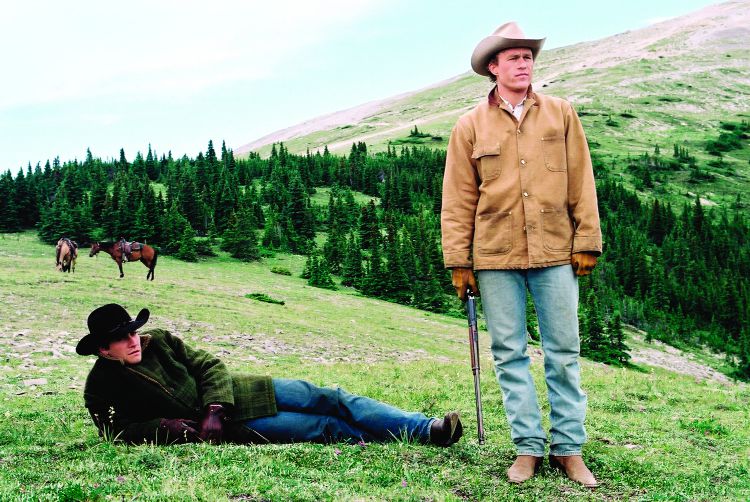
While the comparison might not occur to everyone, Brokeback Mountain (adapted from a 1997 short story of the same name by Annie Proulx, with the movie screenplay written by Diana Ossana and Larry McMurtry) is a spiritual cousin to such films as Witness, Bridges of Madison County, and The Remains of the Day. All four films, while depicting characters living very different lives in different times and places, are at their core about the longing between two people who are unable or unwilling to bridge the gulf that separates them. Obviously, the distinguishing factor setting Brokeback Mountain apart is that its forbidden love affair, unlike the above films, is between two men, and while the homosexual aspect will make some viewers uncomfortable, to pigeonhole it as a “gay cowboy movie”, as some have dismissively done, is a disservice and an oversimplification. The complexity of the characters’ dynamics defy such easy labels. Continue reading
Pride & Prejudice (2005)
DIRECTOR: Joe Wright
CAST: Keira Knightley, Matthew Macfadyen, Rosamund Pike, Brenda Blethyn, Donald Sutherland, Simon Woods, Tom Hollander, Jena Malone, Carey Mulligan, Talulah Riley, Judi Dench, Kelly Reilly, Rupert Friend
REVIEW:
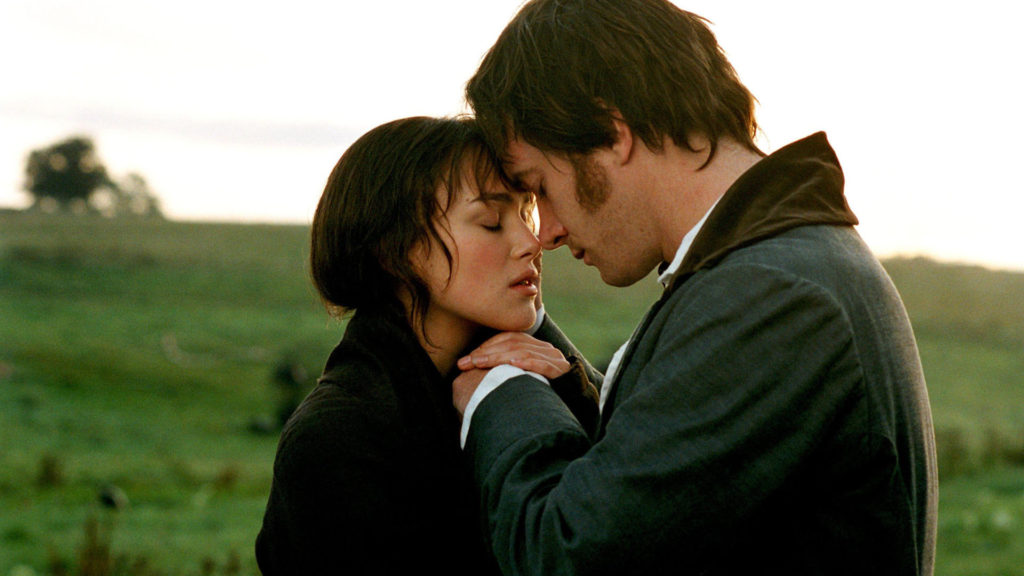
While some will still consider the three-hour 1995 TV miniseries (starring Jennifer Ehle and Colin Firth) to be the definitive onscreen adaptation of Jane Austen’s 1813 novel, Joe Wright and screenwriter Deborah Moggach (and uncredited script doctor Emma Thompson, who starred in Ang Lee’s 1995 adaptation of Austen’s Sense & Sensibility) have done about as good of a job as anyone could expect of adapting the dense material into a two hour format. While various subplots and supporting characters have been condensed, Pride & Prejudice remains a handsome and lively adaptation that sacrifices neither the story’s core themes and heart, nor the central romance.
Continue readingThe Proposition (2005)

DIRECTOR: John Hillcoat
CAST: Guy Pearce, Ray Winstone, Danny Huston, Emily Watson, David Wenham, John Hurt
REVIEW:
With The Proposition, Australian director John Hillcoat and screenwriter/composer Nick Cave have taken the saying “revenge is a dish best served cold” and taken it up—or down, depending on one’s perspective—a notch. The Proposition is considered an unconventional Western, but it doesn’t deal in clear-cut black hats and white hats or simple shoot-em-ups. Brutal, unromanticized, and mercilessly gritty to the point of being disturbing, it’s a grim, haunting odyssey that doesn’t deal in typical crowd-pleasing Western tropes and conventions, at least not straightforwardly.
Continue readingKingdom of Heaven (2005)
 DIRECTOR: Ridley Scott
CAST: Orlando Bloom, Eva Green, Jeremy Irons, Marton Csokas, Brendan Gleeson, Liam Neeson, Ghassan Massoud, Alexander Siddig, David Thewlis, Michael Sheen, John Finch, Edward Norton
REVIEW:
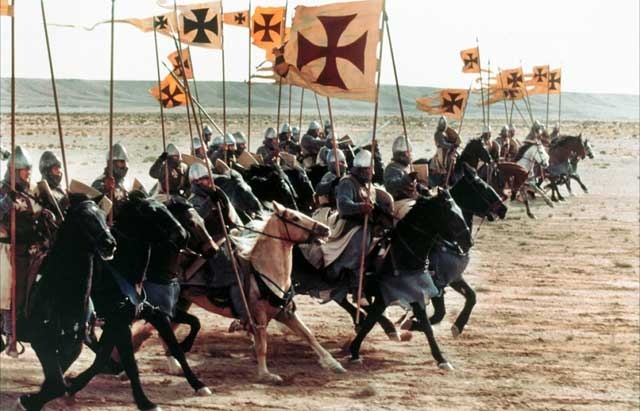
In a number of his previous films, Ridley Scott has proven he knows how to make an epic. With its desert landscape and ancient setting, Kingdom of Heaven bears the closest resemblance to 2000’s Oscar-winning Gladiator, but in some ways is an even more technically ambitious production. Unfortunately, it’s a far less engaging motion picture. Continue reading